
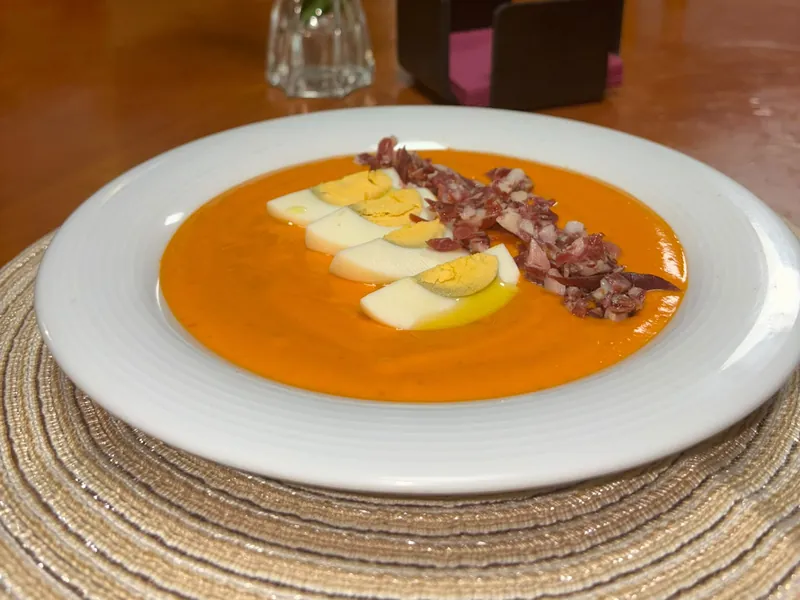
Salmorejo is a thick, cold cream from Córdoba made with just five ingredients: ripe tomato, bread, extra virgin olive oil, garlic and salt. It is blended until smooth and velvety, much denser than gazpacho, and served in a bowl topped with chopped boiled egg and small pieces of Iberian ham.
It is Córdoba's best-known dish, eaten as a starter, as a tapa or as a meal in itself on hot days.
Where does salmorejo come from?
Salmorejo descends from the old cold creams of bread, garlic and oil eaten in the Andalusian countryside, such as mazamorra. When tomatoes arrived from the Americas and became common in Andalusian cooking, those white creams began to be made with them, and salmorejo as we know it today was born.
Today it is such a symbol of the city that there is a Cofradía del Salmorejo Cordobés (a brotherhood devoted to Cordoban salmorejo) that defends its traditional recipe: tomato, bread, extra virgin olive oil, garlic and salt, with a reference ratio of 1 kg of tomatoes to 200 g of bread and 100 ml of oil. That is the ratio we follow in the recipe below.
What is the difference between salmorejo and gazpacho?
Salmorejo is a thick cream of tomato, bread, olive oil, garlic and salt that you eat with a spoon; gazpacho is a thin soup with more vegetables (pepper, cucumber, onion), vinegar and water that you can drink. Order salmorejo if you want something filling, gazpacho if you want something light and refreshing.
| Salmorejo | Gazpacho | Porra antequerana | Ajoblanco | |
|---|---|---|---|---|
| Base | Tomato, bread, oil, garlic and salt | Tomato, pepper, cucumber, onion, garlic, oil, vinegar, water and sometimes bread | Very close to salmorejo: tomato, stale bread, oil, garlic, vinegar and salt | Bread, almonds, garlic, oil, vinegar and water, no tomato |
| Texture | Thick cream, eaten with a spoon | Liquid soup, can be drunk | The thickest: it can be eaten with a fork | White and runny, thinner than gazpacho |
| How it is served | In a bowl, with boiled egg and ham | In a glass or bowl, with chopped vegetables | On a plate, topped with chopped boiled egg | Cold, in a bowl or glass |
| Where it is from | Córdoba | Andalusia in general | Antequera and Archidona (Málaga) | Eastern Andalusia, especially Málaga and Granada |
The key is the ratio: salmorejo has much more bread and no added water, which is why it is so dense. Porra uses almost the same ingredients but is made even thicker; ajoblanco belongs to the other family, the white almond creams, like Córdoba's mazamorra.
Which is healthier, salmorejo or gazpacho?
Gazpacho is lighter: more vegetables and water, less bread and oil. Salmorejo has more calories (a portion with egg and ham is around 480 kcal) because it is thickened with bread and extra virgin olive oil. If you are watching what you eat, have salmorejo as a half portion or without the ham.
How do you make Cordoban salmorejo? Recipe (serves 4)
Ingredients
- 1 kg very ripe tomatoes (plum or vine tomatoes)
- 200 g day-old bread with a dense crumb (in Córdoba, pan de telera)
- 100 ml extra virgin olive oil
- 1 small garlic clove, germ removed
- Salt to taste
- To serve: 2 hard-boiled eggs and 60 g Iberian ham, diced or in shavings
Method
- Wash and chop the tomatoes and blend them with the garlic and salt into a smooth purée.
- Pass the purée through a fine sieve to remove skins and seeds. This step gives salmorejo its silky texture.
- Add the bread, torn into pieces, to the sieved tomato and leave it to soak for about 10 minutes.
- Blend again until there are no lumps of bread left.
- Emulsify with the oil, pouring it in a thin stream while blending, until the cream is thick and glossy.
- Taste and adjust the salt. If it is too thick, add a little more tomato; if it is too runny, a little more bread.
- Chill for at least two hours in the fridge and serve with the chopped egg, the ham and a drizzle of oil.
How do you make salmorejo thick?
- The tomato is everything. The riper and tastier, the better. With bland winter tomatoes, salmorejo turns out pale and flat.
- Bread with a dense crumb. Sliced sandwich bread or baguettes with lots of crust and little crumb don't give the right texture.
- Go easy on the garlic. Raw and cold, it gets stronger over time.
- No water. All the moisture should come from the tomato.
- No vinegar in the most traditional recipe; some households add a dash, but it is not usual in Córdoba.
How do you eat salmorejo?
Cold (never ice-cold) and with a spoon, from a bowl, like a thick soup; plenty of people also mop it up with bread. The classic presentation has chopped boiled egg and Iberian ham on top, with a drizzle of oil. In bars it comes in a bowl as a full portion or in a small size as a tapa, and it is also often used as a sauce: with fried aubergine, flamenquín or chips. It is served cold, never ice-cold.
To drink, a well-chilled beer or a fino from Montilla-Moriles.
How long does salmorejo keep in the fridge?
Well covered in the fridge, it keeps for two or three days. Over time the garlic flavour gets stronger and the cream thickens a little; just stir it before serving. Freezing is not recommended, as the oil emulsion tends to split.
How do we make it at La Galería?
Rafa makes our salmorejo with plum tomatoes, always the same kind, and always in the same proportions: that is how he knows it comes out just right, giving each step the time it needs. We make it midweek, on Wednesday or Thursday, so it is ready for the weekend. We serve it with ham and egg, as a full portion (€12) or a half (€8).
Where to eat salmorejo in Córdoba city centre
At La Galería we serve it with ham and egg, as a full or half portion. It is one of the dishes in our sharing plates section and the most direct way to start discovering typical Cordoban food.