
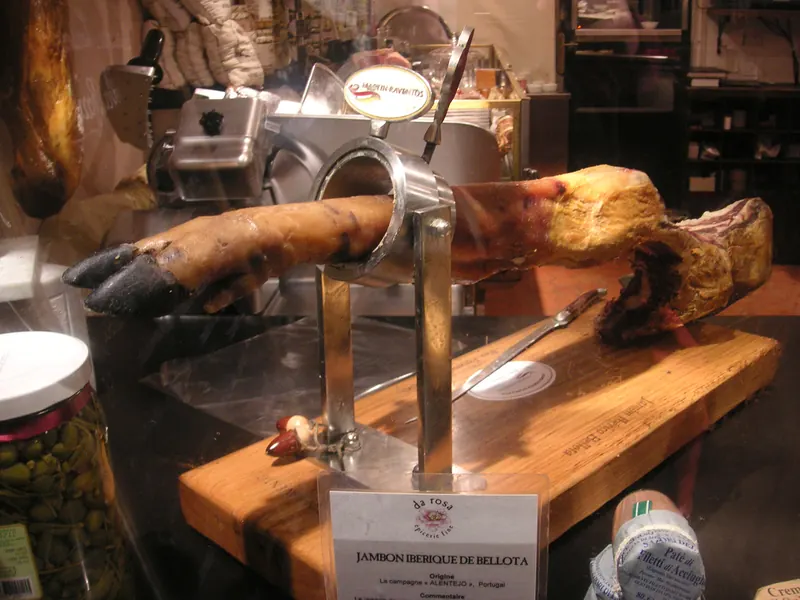
Acorn-fed Iberian ham (jamón ibérico de bellota) comes from pigs of the Iberian breed (wholly or partly) that have roamed freely in the dehesa — Spain's oak wood pastures — eating acorns and grass during the montanera.
You can recognise it by the black or red tag required by Spain's Iberian quality standard: black for 100% Iberian acorn-fed ham and red for cross-bred Iberian acorn-fed ham. And Córdoba has a lot to say here: in the north of the province lies the Los Pedroches PDO, one of Spain's protected designations of origin for Iberian ham.
What do the colours of Iberian ham labels mean?
Black: 100% Iberian, acorn-fed. Red: Iberian, acorn-fed, but not 100% Iberian. Green: Iberian, free-range and grain-fed (cebo de campo). White: Iberian, grain-fed (cebo). Since the 2014 Iberian quality standard, every Iberian ham and shoulder carries this coloured tag showing the animal's breed and diet. It is the most reliable way to know what you are buying or ordering:
| Tag | Official name | What it means |
|---|---|---|
| Black | De bellota 100% ibérico | Sire and dam 100% Iberian breed, fattened on acorns during the montanera |
| Red | De bellota ibérico | Cross-bred Iberian pig (50% or 75% Iberian breed), fattened on acorns |
| Green | De cebo de campo ibérico | Raised outdoors on grass and feed, without a full montanera |
| White | De cebo ibérico | Raised on a farm and fed on grain |
Watch out: "jamón ibérico" on its own does not mean acorn-fed. Only the black and red tags guarantee that the animal was fattened on acorns in the dehesa.
What is the montanera?
The montanera is the final fattening stage of the Iberian pig, which coincides with the fall of acorns from holm and cork oaks, roughly from October–November to February–March. During those months the pigs roam the dehesa eating acorns and grass and put on much of their weight. Acorns are responsible for the marbled, buttery fat rich in oleic acid that makes a good acorn-fed Iberian ham melt in the mouth.
What is the Los Pedroches PDO?
In the north of the province of Córdoba, the Los Pedroches valley is home to one of the largest continuous holm oak dehesas in the Iberian Peninsula. That is where ham with the Los Pedroches Protected Designation of Origin is made — together with Guijuelo, Jabugo and Dehesa de Extremadura, one of Spain's four Iberian ham PDOs. If you want to try an Iberian ham with Cordoban roots, it is the reference.
How can you tell if Iberian ham is acorn-fed?
- Streaks of fat running through the lean meat: the famous marbling.
- Shiny, buttery fat at room temperature, which melts when you touch it.
- A deep red colour in the lean meat, sometimes with tiny white dots (tyrosine crystals, a sign of long curing).
- An intense aroma and a long, slightly sweet, nutty flavour.
How is Iberian ham cut and served?
- At room temperature (about 20–25 °C). Fridge-cold, the fat doesn't melt and it loses all its aroma.
- Thin, small slices with a little fat, cut by hand with a knife, almost translucent.
- Freshly cut. Ham oxidises within minutes; ideally it is cut just before serving.
- On its own or with picos. It needs nothing else. Good bread or a few Cordoban picos (small breadsticks) at most.
To drink, a very cold fino from Montilla-Moriles is the classic pairing: its dryness cleans the palate of fat and gets you ready for the next bite. A well-poured beer also works beautifully.
Which Cordoban dishes use Iberian ham?
Iberian ham is much more than a board of slices: it tops salmorejo, fills flamenquín and flavours puchero and ham croquettes.
Where to eat Iberian ham in Córdoba city centre
On our menu at La Galería there is a full and a half portion of Iberian ham, to share with a beer before moving on to the stews.