
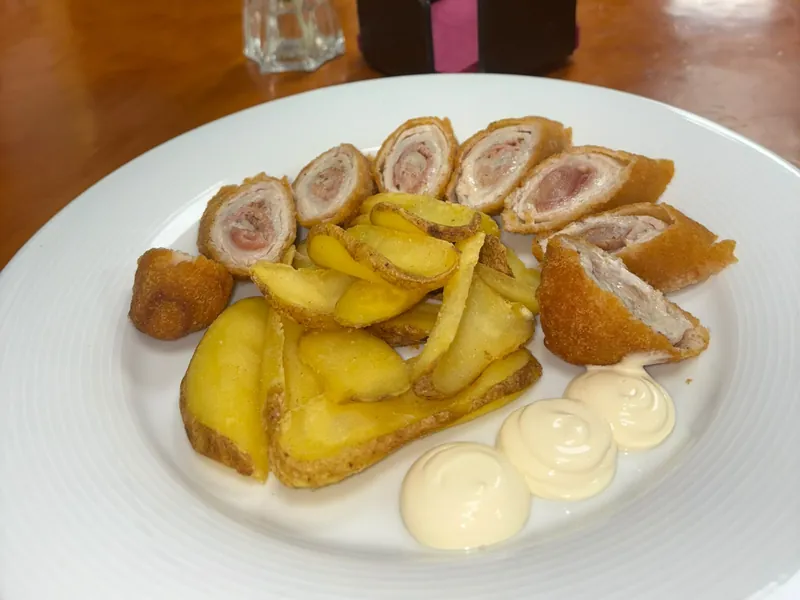
Flamenquín is a Cordoban roll of very thin pork loin fillets wrapped around ham, coated in flour, egg and breadcrumbs and deep-fried until golden and crisp outside and juicy inside.
There is no standard English name for it: menus usually call it a breaded pork and ham roll, or simply keep the Spanish word, flamenquín (plural flamenquines). It is served sliced or whole, almost always with chips and mayonnaise or aioli, and it is one of the most popular bar dishes in Córdoba.
Where does flamenquín come from: Bujalance or Andújar?
It is Cordoban according to the best-supported theory, which places it in Bujalance, in the province of Córdoba; Andújar (Jaén) also claims to have invented it. The Bujalance version is the one backed by the research of University of Córdoba gastro-archaeologist Alejandro Ibáñez. According to accounts of the dish, in 1908 the Diario de Córdoba newspaper was already advertising "ham flamenquín" as a dish of the day, one of the earliest known written references.
What nobody disputes is that today it is a thoroughly Cordoban dish: it is on practically every bar counter in the city and has become one of the flagships of local tapas culture.
Why is it called flamenquín?
There are two popular explanations, neither confirmed. The first links it to its long, slender shape, said to resemble a flamenco dancer. The second connects it with the "flamencos", settlers and courtiers of Flemish origin in past centuries, because of the golden, blond colour of the coating.
How do you make Cordoban flamenquín? Recipe (makes 4)
Ingredients
- 8 thin pork loin fillets (about 400 g in total)
- 8 slices of Serrano ham
- 2 eggs
- Plain flour
- Fine breadcrumbs
- Olive oil for frying
- Salt
- To serve: chips and mayonnaise or aioli
Method
- Flatten the fillets. Place them between two sheets of cling film and pound them with a rolling pin or meat mallet until very thin. Season lightly with salt.
- Build the roll. Lay two fillets overlapping at the edge, cover with two slices of ham and roll up tightly from the short side.
- Chill. Wrap each roll in cling film and leave it in the fridge for 30 minutes so it holds its shape when fried.
- Coat. Dip each flamenquín in flour, then in beaten egg and finally in breadcrumbs. For a crunchier crust, repeat the egg and breadcrumbs.
- Fry in plenty of oil at about 170–175 °C, turning, until golden all over and cooked through.
- Drain on kitchen paper and serve straight away, whole or sliced, with chips and mayonnaise or aioli.
How do you make flamenquín crispy?
- Very thin fillets. If the loin is thick, the roll won't close and the inside stays raw while the outside is already golden.
- Moderate heat. If the oil is too hot, the breadcrumbs burn before the meat is cooked.
- Good ham. It brings the salt and juiciness inside; you don't need to salt the meat much.
- Cold helps. Resting the roll in the fridge before coating stops it from opening up.
What kinds of flamenquín are there?
Besides the classic pork loin and ham version, in Córdoba you will find chicken flamenquín, versions with melted cheese inside or with pepper. There are also small, bite-sized versions made for tapas.
What do you eat flamenquín with?
In Cordoban bars flamenquín is ordered as a full portion to share, cut into slices, with chips and a sauce — mayonnaise or aioli, sometimes salmorejo. It is one of the essential tapas on any tapas route in Córdoba, together with aubergine with honey and croquettes.
How do we make it at La Galería?
Our flamenquín is made by hand in our kitchen, with pork loin and ham. The secret, Rafa says, is to make it with care and tuck a little Iberian pork fat inside. We serve it with chips and aioli (€12.50), and it is one of our most-ordered dishes.
Where to eat flamenquín in Córdoba city centre
On our menu at La Galería it is in the meat section: pork flamenquín with chips and aioli. If you are coming as a group, it is one of the dishes that works best in the middle of the table.