
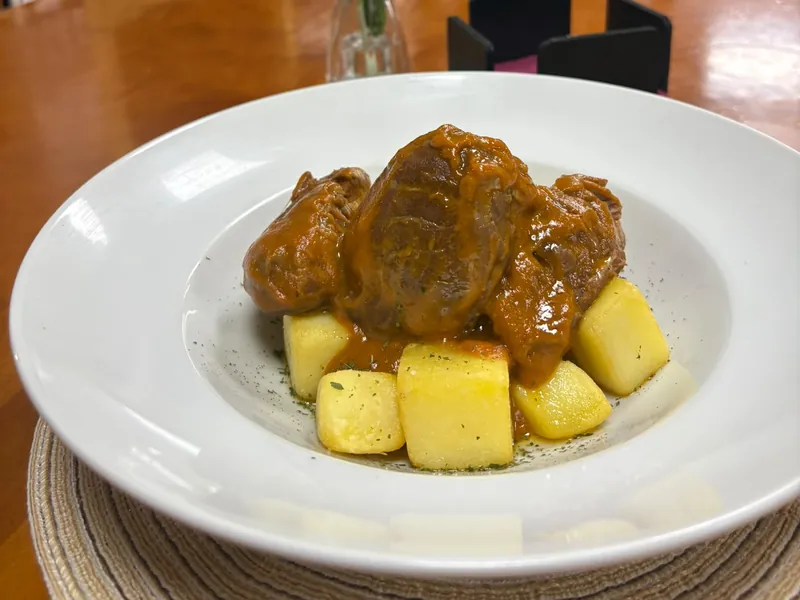
Rabo de toro is Córdoba's oxtail stew: bull or beef oxtail cut into pieces, browned and slow-cooked for several hours with vegetables and wine, until the meat slides off the bone and the sauce is thick and glossy.
Together with salmorejo, it is the most representative dish of Cordoban cuisine and one of the great stews of Spanish cooking.
What is the origin of rabo de toro?
Tradition links the dish to bullfighting: the tail was an undervalued cut that was not wasted and ended up in the humblest kitchens, where slow cooking turned it into a delicacy. It is a widely told explanation, although hard to document precisely; what is clear is that rabo de toro is a perfect example of the Andalusian cooking of making the most of every cut.
Today, in practice, most of the oxtail cooked comes from beef cattle rather than fighting bulls, and the dish is made in bars and restaurants in Córdoba all year round, not just during the bullfighting season.
Is oxtail the same as rabo de toro?
In practice, yes: "rabo de toro" is the Spanish name of the dish, and the tail used today is almost always beef oxtail rather than fighting bull. All three are the tail of an adult bovine and are stewed the same way; what changes is the animal. A toro is a fighting bull, a buey (ox) is a castrated male and a vaca is a cow. Fighting-bull tail is scarce and true ox is barely reared any more, so the "rabo de toro" served in most bars is actually beef, usually cow. In English, "oxtail" is simply the name for any beef tail.
| Rabo de toro (bull) | Rabo de buey (ox) | Rabo de vaca (cow) | |
|---|---|---|---|
| Animal | Male over 48 months; according to Spain's consumer association OCU, only fighting bulls | Castrated male over 48 months | Female over 48 months |
| Availability | Scarce: depends on bullfights | Very rare: rearing an ox is slow and expensive | The most common at the butcher's |
| How it is sold | The dish name is used for any beef tail | Cow is often labelled as ox | Often sold as "bull" or "ox" tail |
| On the plate | The same stew: hours over a low heat with vegetables and wine until the meat comes off the bone | ||
For someone eating it in a bar, the real difference lies in the stew (time, wine, skimming the fat) rather than the animal. If the origin matters to you, ask: a serious place will tell you where its oxtail comes from.
How do you make Cordoban rabo de toro? Recipe (serves 4–6)
Ingredients
- 2 kg bull or beef oxtail, cut at the joints
- 2 onions, 2 carrots, 1 leek and 1 red pepper
- 4 garlic cloves
- 2 ripe tomatoes, grated
- 500 ml red wine or Montilla-Moriles oloroso
- Beef stock or water, enough to cover
- 2 bay leaves, black pepper and, if you like, a clove
- Flour, extra virgin olive oil and salt
Method
- Prepare the meat. Season the oxtail pieces, dust them in flour and brown them on all sides in hot oil. Set aside.
- Make the base. In the same oil, gently cook the chopped onion, carrot, leek, pepper and garlic over a medium heat for about 20 minutes. Add the tomato and cook for 5 more minutes.
- Add the wine. Return the meat to the pan, pour in the wine and let it bubble for a few minutes to cook off the alcohol.
- Stew slowly. Cover with stock or water, add the bay leaves and spices, put the lid on and cook over a very low heat for 3 to 4 hours, until the meat comes away from the bone when touched. In a pressure cooker, about 50–60 minutes.
- Finish the sauce. Take out the oxtail pieces, blend the sauce and pass it through a sieve if you want it smooth. Reduce it if it is too thin.
- Rest. Put the meat and sauce back together and leave to rest; like all stews, it is even better the next day.
How do you make rabo de toro tender?
- Skim the fat. Oxtail releases a lot of fat. If you cook it the day before, the fat sets on the surface as it cools and is very easy to remove.
- Don't rush it. The collagen in oxtail needs hours to turn into gelatine. If the meat is tough, it needs more time.
- The wine matters. A full-bodied red gives a more intense sauce; a Montilla-Moriles oloroso adds very Cordoban toasty notes.
- Salt at the end. The sauce concentrates a lot as it reduces; adjust the salt at the last moment.
What do you serve with rabo de toro?
The classic in Córdoba is homemade chips and plenty of bread to mop up the sauce. More restaurant-style versions come with mashed potato. To drink, a full-bodied red or an oloroso. And if there is meat left over, it becomes oxtail croquettes.
What is the difference between rabo de toro and carrillada?
They share the technique, but oxtail has a bone, more fibrous meat and a stronger flavour; carrillada (pork cheeks) is more tender and boneless. If you come to Córdoba and want to try its slow-cooked stews, the ideal is to share both.
How do we make it at La Galería?
Rafa cooks the oxtail for about 4 hours, always with local wine. It is cooked on the same day it is served. It is on our menu at €20.
Where to eat rabo de toro in Córdoba city centre
Rabo de toro is one of the dishes in our meat section at La Galería, and you can also have it as a tapa in the form of oxtail croquettes. At weekends, it is best to book.