
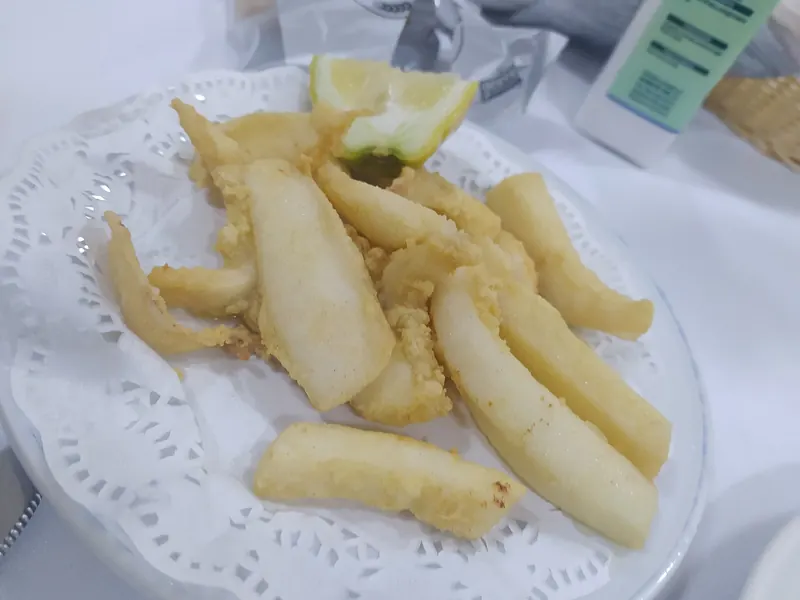
Fried fish in Córdoba, known locally as pescaíto frito, is fish and cuttlefish dusted in flour and fried in plenty of oil: strips of choco (cuttlefish), japuta en adobo, dogfish, anchovies or salt cod, served straight from the pan with lemon. It is fried all over Andalusia, and in Córdoba you order it as a full portion, a half portion or to share standing at the bar.
Here is what each piece is, what goes into the marinade, how to order, what to drink with it and how to make tender fried cuttlefish at home.
What is pescaíto frito and why is it so popular in Córdoba?
It is fish, plus the odd cephalopod such as cuttlefish, coated in flour and fried in very hot oil. There is no egg and no breadcrumbs: just a thin layer of flour that turns crisp and keeps the inside juicy.
According to the Spanish-language Wikipedia entry, larger fish such as dogfish (cazón) are cut into pieces and sometimes marinated in adobo before frying, and cuttlefish is cut into rings. It is the staple of the freidurías, shops that specialise in frying fish.
You can see how established it is in Córdoba on tavern menus. Directo al Paladar's guide to eating in Córdoba lists japuta in adobo among the dishes of the city's taverns and gives an honourable mention to fried fish. elDiario.es includes japuta in adobo among the Cordoban delicacies to go with Montilla-Moriles wine. It sits alongside salmorejo and flamenquín as part of everyday Cordoban food.
What is japuta in adobo? Japuta or palometa?
Japuta en adobo is japuta cut into pieces, marinated in vinegar, garlic and spices, then floured and fried. "Japuta is nothing more and nothing less than the black pomfret", explains the cook Rosa Tovar in her recipe for Guía Repsol.
Its scientific name is Brama brama, known in English as Atlantic pomfret. According to Wikipedia, in Spanish it goes by palometa negra, palometa, castañeta or zapatero, and in some areas ibraima or japuta. In Córdoba you order it by that last name.
What goes into Andalusian adobo?
Adobo is a marinade of vinegar, garlic, spices and paprika in which the fish rests for several hours before frying. It gives a sharp, spiced flavour that sets dogfish or japuta in adobo apart from plain fried fish.
Two reference recipes agree on the essentials:
- Guía Repsol (japuta in adobo): cumin, cloves, pepper, garlic and oregano pounded in a mortar, plus paprika, vinegar, oil and water.
- ¡HOLA! Cocina (dogfish in adobo): white wine vinegar, garlic, oregano, cumin, sweet paprika, salt and water.
Both share vinegar, garlic, cumin, oregano and paprika. The cloves and pepper in Rosa Tovar's version make it a little more aromatic.
How long should fish marinate in adobo?
¡HOLA! Cocina recommends 8 to 12 hours; the Guía Repsol recipe says overnight or longer. In other words, it is prepared the day before. Next day the fish is drained, coated in frying flour or chickpea flour and fried in hot oil.
What is choco, and why are people from Huelva called choqueros?
Choco is the common cuttlefish (Sepia officinalis), and it is the name used in Huelva. It is so central to the cooking there that, as Barceló's travel guide notes, people from Huelva are popularly known as choqueros.
Fried choco is a typical Huelva dish that is also a regular in Córdoba's bars. It comes in strips or rings, with lemon or a sauce.
Nor is it the same as squid. Both are cephalopods, but they are different animals. If the menu says choco, it is cuttlefish.
What else gets fried? Anchovies, dogfish, salt cod…
A mixed fry usually combines several pieces. These are the ones you will see most:
- Dogfish in adobo (cazón en adobo): the other great Andalusian adobo. Wikipedia gives it as the example of a larger fish that is cut up and marinated before frying.
- Anchovies (boquerones): small fish. For small pieces, the International Olive Council puts the frying temperature at 175 to 190 °C. In Córdoba's taverns you will also find them in vinegar.
- Fried salt cod (bacalao frito): floured pieces. At La Galería it comes with piquillo pepper jam and salad.
Not everything from the fryer is fish: fried aubergine with honey is another Cordoban fried dish that shares the table with pescaíto.
How do you order it: full portion, half portion or paper cone?
In a Córdoba bar you order fried fish like any other dish for sharing: a ración (full portion) if there are several of you, or a media ración (half portion) if you want to try more things. In freidurías it is also commonly served in a cartucho, a paper cone, to take away or eat standing up.
For reference, these are the prices of the fried dishes at La Galería:
| Dish | Full portion | Half portion |
|---|---|---|
| Fried cuttlefish strips with lime mayonnaise and salad | €14.00 | €9.00 |
| Fried salt cod with piquillo pepper jam and salad | €14.00 | €9.00 |
| Fried cuttlefish with chips or salad (children's menu) | €7.50 | - |
Our suggestion for two people: order two different half portions, cuttlefish and cod, rather than one full portion. You try both for €18. There are more ideas for ordering at the bar in our guides to tapas in Córdoba and cheap eats in Córdoba, and every dish is on the menu.
What do you drink with fried fish?
The most Cordoban choice is a well-chilled Montilla-Moriles fino; the everyday alternative is a caña, a small draught beer. According to the appellation's Regulatory Council, fino is a dry wine aged biologically through the criaderas and solera system.
The Regulatory Council itself recommends fino with "seafood and fish" and as an aperitif. Drinking it with fried fish is bar custom rather than an official pairing for this dish, but it fits that recommendation. For more on these wines, see our guide to Montilla-Moriles wine.
If you prefer beer, at La Galería a caña costs €1.80 and a bottle €2.50; a glass of house wine is €2.50.
How do you make choco frito at home? Recipe (serves 4)
Fried cuttlefish works well at home if you look after two things: keeping the cuttlefish tender and keeping the oil hot. This recipe follows the technique described by Directo al Paladar and Aceites de Oliva de España.
Ingredients
- 500 g cleaned cuttlefish (fresh, frozen beforehand so it turns out more tender)
- 100 g plain wheat flour
- 100 g chickpea flour (or special frying flour)
- Salt
- Plenty of olive oil
- Lemon
- Optional: mayonnaise with grated lime zest (the way we serve it at La Galería)
Method
- Freeze the cuttlefish. If it is fresh, put it in the freezer for a couple of days, then thaw it in the fridge.
- Cut into strips. Rinse the cuttlefish, dry it very well with kitchen paper and cut it into 1 cm strips.
- Flour it. Mix the two flours, salt the cuttlefish, toss it in the flour and shake off the excess.
- Heat the oil. Bring plenty of olive oil to about 180 °C. Without a thermometer, drop in a cube of bread: it should rise and brown straight away.
- Fry in batches. Add a few strips at a time and fry for about 2 minutes, until golden.
- Drain and salt. Lift them onto a plate lined with kitchen paper and season with a little salt.
- Serve at once. With lemon or lime mayonnaise, while still hot.
Tip: freezing fresh cuttlefish is not an extra step for nothing. According to Directo al Paladar, the cold breaks down the fibres and the cuttlefish turns out more tender.
Tip: don't overcrowd the pan. Too much cuttlefish at once cools the oil and the result is soft and greasy. Olive oil copes well with the heat: the International Olive Council puts its smoke point at around 210 °C, above the 180 °C recommended for frying.
Where can you eat fried fish in Córdoba city centre?
At La Galería, at Avenida Ronda de los Tejares, 34, next to Gran Capitán boulevard, we have two fried dishes on the menu: fried cuttlefish strips with lime mayonnaise and salad, and fried salt cod with piquillo pepper jam and salad. Both cost €14 for a full portion and €9 for a half. For children there is fried cuttlefish with chips or salad for €7.50.
Japuta, dogfish and anchovies are not on our menu: at La Galería we serve cuttlefish and salt cod. We fry them to order for the bar, the dining room or the terrace. The kitchen opens at 8:30. We are open Monday to Wednesday from 8:30 to midnight, Thursday to Saturday from 8:30 to 2:00 am and Sunday from 8:00 to 16:00. To round off the table, add aubergine with honey and a salmorejo. See the full menu or book a table.
Sources and references
- Guía Repsol: Japuta en adobo, Rosa Tovar, 2021 (in Spanish)
- Wikipedia: Brama brama (in Spanish)
- Wikipedia: Pescado frito
- Wikipedia: Pescaíto frito (in Spanish)
- Directo al Paladar: where to eat well and cheaply in Córdoba, 2026 (in Spanish)
- elDiario.es: Córdoba Patios festival, 2018 (in Spanish)
- ¡HOLA! Cocina: how to make cazón en adobo (in Spanish)
- Barceló: typical food of Huelva, 2024 (in Spanish)
- Directo al Paladar: chocos fritos, traditional Andalusian recipe, 2025 (in Spanish)
- International Olive Council: olive oil (in Spanish)
- Aceites de Oliva de España: pescaíto frito (in Spanish)
- Montilla-Moriles Regulatory Council: fino pairings (in Spanish)
- Montilla-Moriles Regulatory Council: wines (in Spanish)